
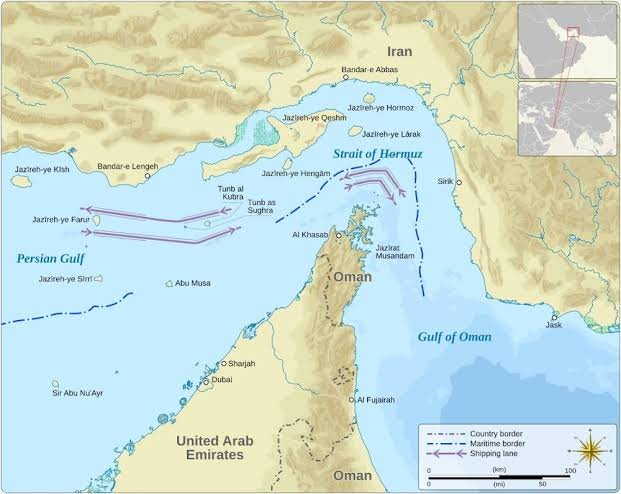
China is one of the largest consumer and importer of oil and natural gases. Its energy requirement come from diverse region, including the Middle East. The Strait of Hormuz remains an important channel for China to achieve its energy security needs. However, Iran and Israel conflict backed by the United States have led energy supply chain shocks around the world. Among others, China is also affected. Its economic stability and national security are explicitly linked with oil and gases, although it has boosted its renewal energy sector as potential policy direction to manage external supply shocks, Global South needs to step up to invest in renewable energies become strategically independent and avoid victimhood of resources weaponizing.
China’s Dependence, Challenges and Resilient
The Strait of Hormuz is not just a narrow pass, but a strategic chokepoint through which oil, gases, fertilisers, etc are shipped. In 2025, this route recorded passing on an average of 20 million barrels per day of crude oil and other products. Besides Iran, several other Arabian countries dependent on Hormuz to export oil, such as Iraq, Kuwait, Bahrain, Qatar, etc. The disruption in the strait due to war would affect exporting as well as importing countries. Qatar and the UAE account together about 20% of global LNG exports. Their more than 90 percent of LNG is transported through the Strait. The closing of Strait would have multifaceted effects for national and international economies. The rising prices of Oil also contribute in the rise of fertilizer prices, study shown between Jan 1990 to Feb 2026 during different set of events the prices of fertilizers also increased led unprecedented global crisis.
Energy security is the requirement of all countries. China is not an exception. It imports from various regions, along with strengthening its domestic resilient capacity by investing heavily in the renewable energy sources for green future. As a global south country, it has emerged as a strategic player in green technologies in last decade. Given its rise in renewable energy sector, amidst current war in Middle East, global south countries in Africa and Southeast Asian countries already have imported solar panel from China as war has increased the demand among countries. The Middle East situation has opened up eyes and minds of countries to look beyond traditional energy sector to adopt more sustainable source of energy and achieve UN Sustainable Development Goals as well.
It is believed that China has a goal of to achieve the peak in Carbon emission by 2030 and carbon neutrality by 2060, with keeping these goals in mind it has pursued investing in renewable energy and Net Zero target. Statistics show between 2009 and 2021, Chinese installed electricity generating capacity have increased from earlier 874 to 2374 million kW and yearly power generation from 3697 to 8537 billion kWh.

Source: Oxford Institute for Energy Studies, March 2026
The figure reveals that in the year of 2025, compared to previous years, China has imported roughly half of its crude from this region, which includes of its dependence for naphtha and 45 percent of its LPG. To protect its economic interests, Chinese have deployed naval forces around the Strait of Hormuz without fearing of United States forces which counter-blockade the strait to reduce energy trade and target Iran’s revenue sources
China’s Efforts
Iran’s conflict has direct implications on Chinese energy sector in three ways: disruption of supply chains, closure of Hormuz and other Gulf countries set to cut oil production as the result the price of oil per barrel gone above USD 100. China has moved towards and is self-sufficient in energy supply and renewable energy which already overtaken oil in the year 2024 as the second largest source of energy. Since the war began in the region, China has adopted “an objective, just and balanced position”, and working to bring parties to ceasefire table like other developing countries, such as India and others.
Chinese spokesperson says regarding Iran conflict, that “their top priority is to bring an immediate end to the military operations and return to dialogue and negotiations, and restore peace and stability in the region”.
Winning Strategy despite War effects
Pundits often overlook the lessons from other countries. China, as reported, is the “clear winner” by manufactured resiliency in times of crisis and prepared for future, and “better off” in the post-war order given its growing leadership in what President Xi calls the ‘new trio’, which consists of solar panels, lithium-ion batteries and EVs areas.
China’s Custom Statistics reveal that in the first three quarters of China’s foreign trade in 2025 climbed up RMB 33.61 trillion, shown consecutively 4 percent growth wherein exports increased by 7.1 percent and imports down by 0.2 percent in the same year.
Having said that and taken into knowledge the challenges world facing, President Trump and President Xi have scheduled meeting in next month, 14th and 15th May, in China. Before the scheduled meeting, the Hill reported that Xi says “for first time Strait of Hormuz should be reopened”, to create a mutual comfortable ground for the meeting. Last time both leaders had met in Busan, on October 2025 to ease trade disputes. Western scholarship has constructed and selling a narrative of the Iran War as a win for China in many ways. Global South countries understand the duplicity of United States as volatile dominant power have been involved in regime changes around countries.
Conclusion
Strait of Hormuz with less doubt has shown an Achilles hill for global economy. For China, it is important for its energy requirements, but not being future vulnerability as it is and has transformed its energy sector towards green and renewal energies, which set to export to Global South countries, some already expressed interests. Trojan horse moment the world still is awaiting in the strait to control strategic ports of Iran, there is a caution need to be taken by conflicted parties. The developing and least developed countries have most suffered from the strait crisis, its an eye-opening moment to take policy measures and avoid future effects.