
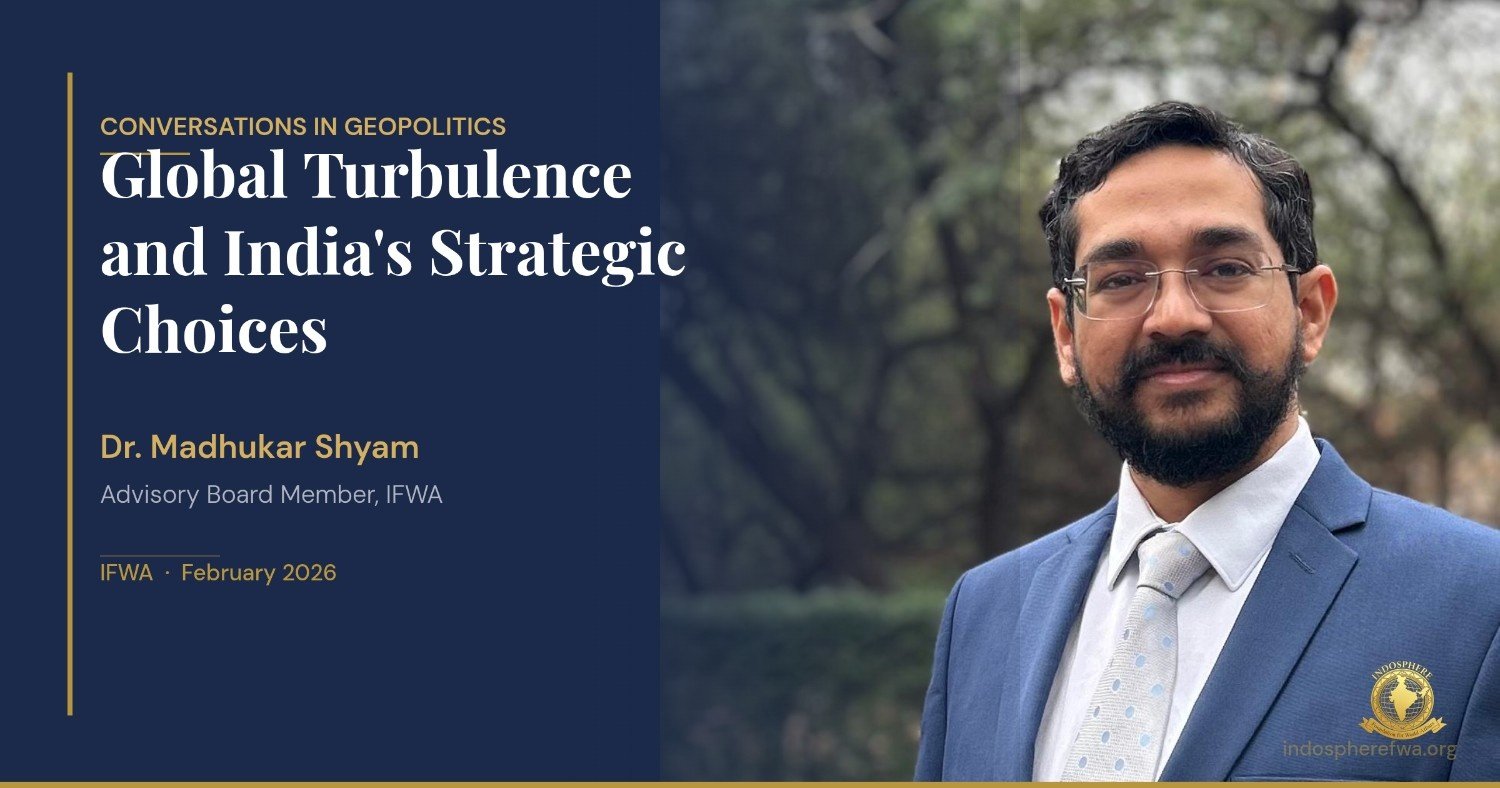
A Conversation with Dr. Madhukar Shyam, Advisory Board Member, IFWA
Introduction
In an era marked by geopolitical volatility, shifting power balances, and renewed great-power competition, understanding the contours of global order has become increasingly critical. In this conversation, Dr. Madhukar Shyam — Assistant Professor at Christ University, expert in foreign policy and security affairs, and Advisory Board Member of the Indosphere Foundation for World Affairs — offers insights into US–China rivalry, India's strategic positioning, West Asian geopolitics, and the evolving role of platforms like the Raisina Dialogue.
Q1. What were the key geopolitical themes that emerged from this year's Raisina Dialogue?
Dr. Madhukar Shyam : This year's Raisina Dialogue unfolded against the backdrop of a deeply turbulent international system. At its core is the structural rivalry between the United States and China, which reflects a broader contest over global leadership. This can be understood through the lens of hegemonic stability theory — essentially, a struggle over who will define and sustain the international order. Alongside this, the Russia–Ukraine war continues to represent a major fault line, rooted in tensions between Russia and Western Europe, particularly over NATO expansion. This prolonged conflict signals a return to sustained, large-scale warfare even in an era often described as dominated by smart or hybrid warfare. Another important dimension is the instability in West Asia, particularly surrounding Iran's nuclear ambitions. The collapse of the earlier P5+1 framework and renewed unilateral pressure from the United States have contributed to escalating tensions in the region. Taken together, these developments reflect a fragmented and contested global order in which multiple conflicts are unfolding simultaneously, rather than a single dominant axis of tension.
Q2. How should we understand the nature of US–China competition? Is it accurate to describe it as a 'Cold War'?
Dr. Madhukar Shyam : It would be inaccurate to describe US–China relations as a Cold War. The defining feature of the Cold War was the absence of deep economic interdependence. In contrast, the US and China today are highly interdependent, particularly in trade, supply chains, and critical resources. For instance, China dominates the production and processing of rare earth minerals, which are essential for advanced technologies and industrial production. The United States remains dependent on these resources, even as it seeks to strategically compete with China. At the same time, China has demonstrated its ability to retaliate — such as restricting exports of rare earth elements during periods of tension. This indicates that the competition is not purely military or ideological, but deeply embedded in economic and technological domains. Therefore, rather than a Cold War, what we are witnessing is a complex strategic rivalry marked by both competition and interdependence.
Q3. Given internal economic challenges, how viable is China's bid for global hegemony?
Dr. Madhukar Shyam : China's trajectory toward becoming a global power must be understood as a long-term strategic project. Its vision extends to 2049, and its policies are aligned with that goal. While it is true that China has faced economic slowdowns — what it calls a "new normal" characterised by lower growth and rising unemployment — it is simultaneously restructuring its economy. There is a strong push toward automation and advanced manufacturing, reducing dependence on labour-intensive production. China is also investing heavily in securing long-term energy supplies. It has signed extensive agreements with countries like Iran and Russia and is actively asserting its presence in maritime regions such as the South China Sea. Importantly, China benefits from policy continuity. Unlike the United States, where foreign policy priorities can shift with administrations, China's governance structure allows it to pursue long-term strategic goals with consistency. Thus, while challenges exist, it would be premature to discount China's ambitions. The outcome of this competition remains uncertain.
Q4. China has expanded its presence in West Asia. How does this affect India's strategic interests in the region?
Dr. Madhukar Shyam : India's approach to West Asia has evolved into a more nuanced and multi-dimensional strategy. Historically, India maintained strong relations across the region, including with Iran and Palestine. Today, it has expanded its engagement to include deeper ties with Israel, particularly in defence and technology. China's growing presence in West Asia is primarily driven by its need to secure energy supplies. However, this does not necessarily undermine India's position. West Asia is a vast and resource-rich region, and no single country can dominate its economic relationships entirely. India remains a major consumer of energy, which gives it a natural advantage in maintaining strong ties with regional producers. At the same time, West Asian economies themselves are diversifying — moving toward services, tourism, and education — which opens new avenues for engagement with India. In essence, India and China have different priorities in the region: China is focused on securing supply chains, while India is focused on consumption and broader strategic partnerships.
Q5. What are the key factors that will shape India–China relations over the next decade?
Dr. Madhukar Shyam : Three major factors will define the trajectory of India–China relations. First,the unresolved border dispute will remain a persistent source of tension. China has shown little interest in a final settlement and often uses border tensions as a strategic tool to exert pressure. Second, China's indirect strategy — particularly through its relationship with Pakistan — will continue to influence India's security environment, adding a layer of complexity beyond direct bilateral engagement. Third, India will increasingly rely on multilateral and minilateral platforms. Through groupings like the Quad, India will push for principles such as freedom of navigation, particularly in the Indo-Pacific. At the same time, it will engage China within forums like BRICS and SCO to manage competition. Overall, the relationship will likely remain a mix of competition, limited cooperation, and strategic caution.
Q6. How do platforms like the Raisina Dialogue contribute to India's role in global diplomacy?
Dr. Madhukar Shyam : The Raisina Dialogue has emerged as a significant platform in global strategic discourse. It brings together policymakers, academics, and practitioners from across the world, facilitating both formal and informal exchanges. Its importance lies in its role as a Track 1.5 and Track 2 diplomatic platform. It allows governments to signal their positions, build coalitions, and shape narratives without the rigidity of formal negotiations. Additionally, it provides space for side-line engagements, where critical discussions can take place outside official frameworks. In that sense, it strengthens India's position as a convening power — capable of bringing diverse stakeholders together to deliberate on global challenges.
Editors' Note :
"This conversation underscores a central challenge for Indian strategic thinking: navigating a world of simultaneous, intersecting rivalries without the luxury of clear alignments. Dr. Shyam's analysis highlights that India's strength lies not in choosing sides, but in leveraging its position as a major consumer, a convening power, and a credible participant across competing multilateral frameworks. As India's global profile rises, the ability to sustain this balancing act — across West Asia, the Indo-Pacific, and Eurasian institutions alike — will define the next phase of its foreign policy."
Dr. Madhukar Shyam
Assistant Professor at Christ University, Bengaluru, specialising in foreign policy analysis and security studies. Advisory Board Member, Indosphere Foundation for World Affairs (IFWA), Gujarat.
Keywords:
US China rivalry India, India West Asia strategy, Raisina Dialogue 2026, India China relations, hegemonic stability theory India, Indian think tank geopolitics, IFWA interview, Track 1.5 diplomacy India, India strategic autonomy, Indo-Pacific India policy